

On Friday last week the NortHFutures delivered the annual Digital Health Symposium with our NHS partners. This was the fourth event of its kind and the second that NortHFutures has supported with Health Data Research (HDR) UK.
This year’s symposium theme was 'Future Ready: Digital Health for Tomorrow’s NHS’, and the programme represented diverse professional perspectives from across different sectors of work, including Health and Care, Further and Higher Education, industry and Voluntary Community and Social Enterprise (VCSE).
NHS workforce, trainee doctors and allied health professionals were well-represented on the delegate list, but it also included attendees from universities and colleges, local companies and VCSE organisations. This diversity feels crucial for the rich discussions on Digital Health that this forum is valued for.
The symposium opened with reflections from Professor Namita Kumar (National Dean for PGMDE Risk and Business Oversight), on the NHS 10 Year Health Plan and how help our NHS workforce and trainees develop digital readiness through national education quality improvement.
Dr Alec Price Forbes (National Chief Clinical Information Officer) invited us to re-imagine how the NHS delivers care for ‘Digital by Default’, and highlighted the need to educate, innovate, research and evaluate to harness the power of data. He also highlighted how the NHS app provides the foundations for a Digital by Default NHS. Namita and Alec both framed well how we need to support the NHS workforce in specific ways to realise the digital by default vision.
Angela MacOscar (Head of Innovation at Northumbria Water) offered fascinating insight on how the company is driving innovation - further demonstrating the value of sharing insight across sectors. Angela emphasised how applying a mix of specialist expertise is important for addressing challenges, and how data is useless unless we find insight in it and apply this insight with purpose - this requires openness to adapt, persevere, and stay curious.
Karen Connelly, (CCIO and Consultant in Critical Care Medicine and Anaesthesia for Northumbria Healthcare NHS Foundation Trust) raised the importance for digitally mediated work and implementation changes to be clinically led to sustain and evolve best practice, positing that digital transformation will not be achieved with technology alone: engaging and supporting the workforce through change is critical to success.
And a series of lightening talks demonstrated case studies of innovation at our region's front line, which were hugely inspiring. Thank you to contributors Dr Kavita Chawla, Dr Atit Ghoda, Dr Rabia Gul, and Mr Oliver Kennion.
A panel debate was held about whether patients should have full access to their electronic health record, bringing into conversation Angela Coulter (Chair of Understanding Patient Data), Dr Daniel Weiand (Consultant Medical Microbiologist Newcastle Upon Tyne Hospitals NHS Foundation Trust), and Dr Michael Smith (Associate CCIO for the North East and North Cumbria Integrated Care Board).
The afternoon was defined by discussions on the importance of involving end users in health tech innovation. We held two breakout sessions. One panel session was chaired by Nikhil Premchand (CCIO at Northumbria Healthcare NHS Foundation Trust) with Richard Leonard (Deputy Director of Digital Development and Data for Northumbria Healthcare NHS Foundation Trust), and Edward James (Director of Procurement at Humber & North Yorkshire Procurement Collaborative), debating Build versus Buy and getting the balance right. Echoing Karen’s words earlier: digital is an enabler and not the solution; if we buy things then we need to work out who owns them, who manages them, and who uses them.
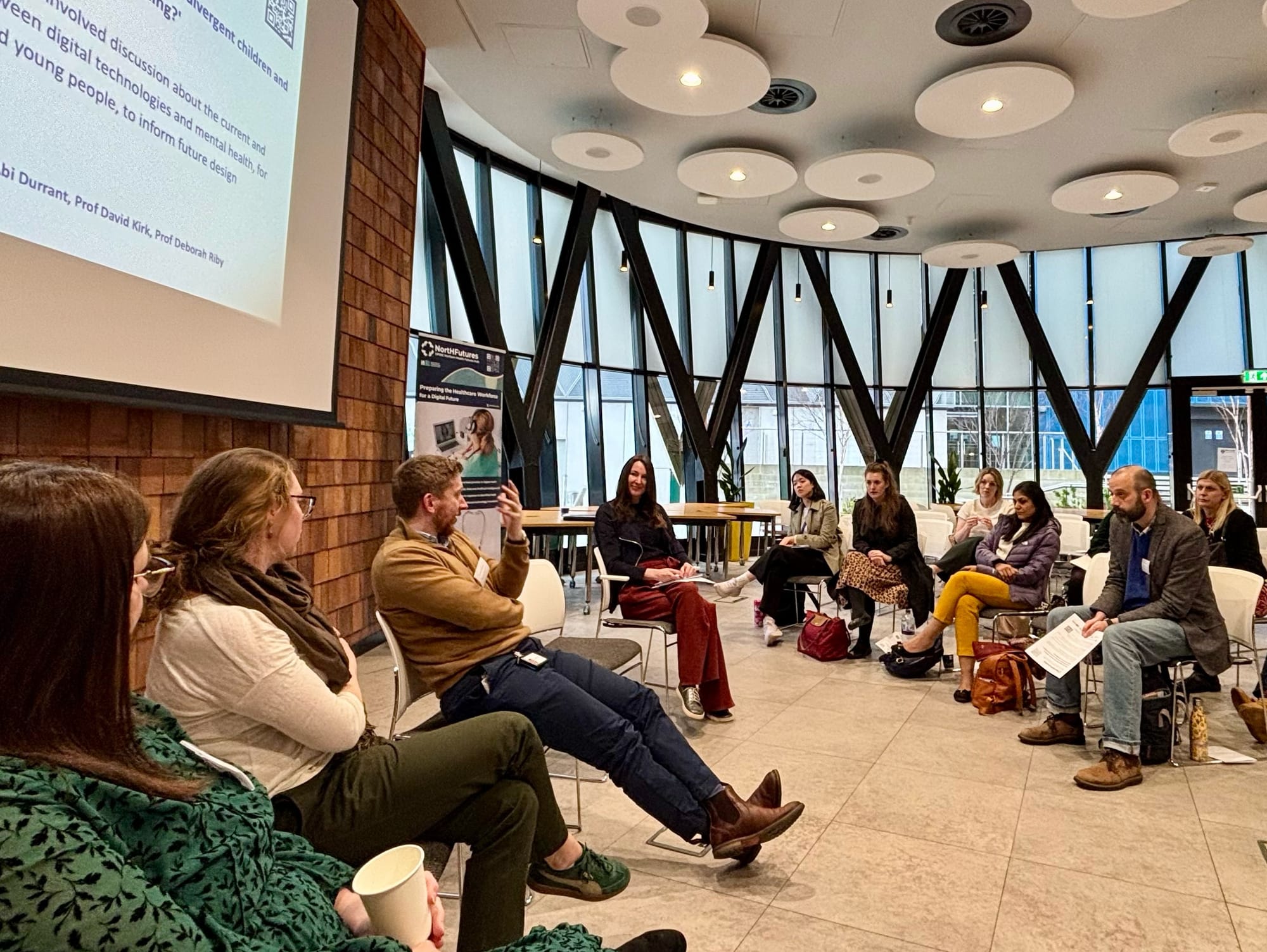
The second breakout panel explored digital innovation and supporting neurodivergent children’s mental health and wellbeing. Abigail Durrant, Professor of Interaction Design, and David Kirk, Professor of Human Computer Interaction at Newcastle University convened a discussion with Professor Deborah Riby, (Co-Director of the Centre for Neurodiversity & Development, Durham University) and Dr David Anderson, (Consultant Psychiatrist at CNTW NHS Trust), using an interactive format that invited audience participation. Noting the urgent need to address increasing demand for mental health services, David asked so how can AI and digital help? Debbie asked: How can tools be co-designed with neurodivergent users to be ethical, equitable and safe?
Dr Kate Preston (Research Associate in Safe and Human-centred AI University of York) gave an excellent closing keynote presenting a real-world application of human-centred AI in digital health and highlighted the importance for responsible innovation to be grounded in understanding human factors.
Our NortHFutures organising team were: Katie French, Sophie Gould, David Kirk, Abigail Durrant, Emma Letham, and Jennifer Wood.